
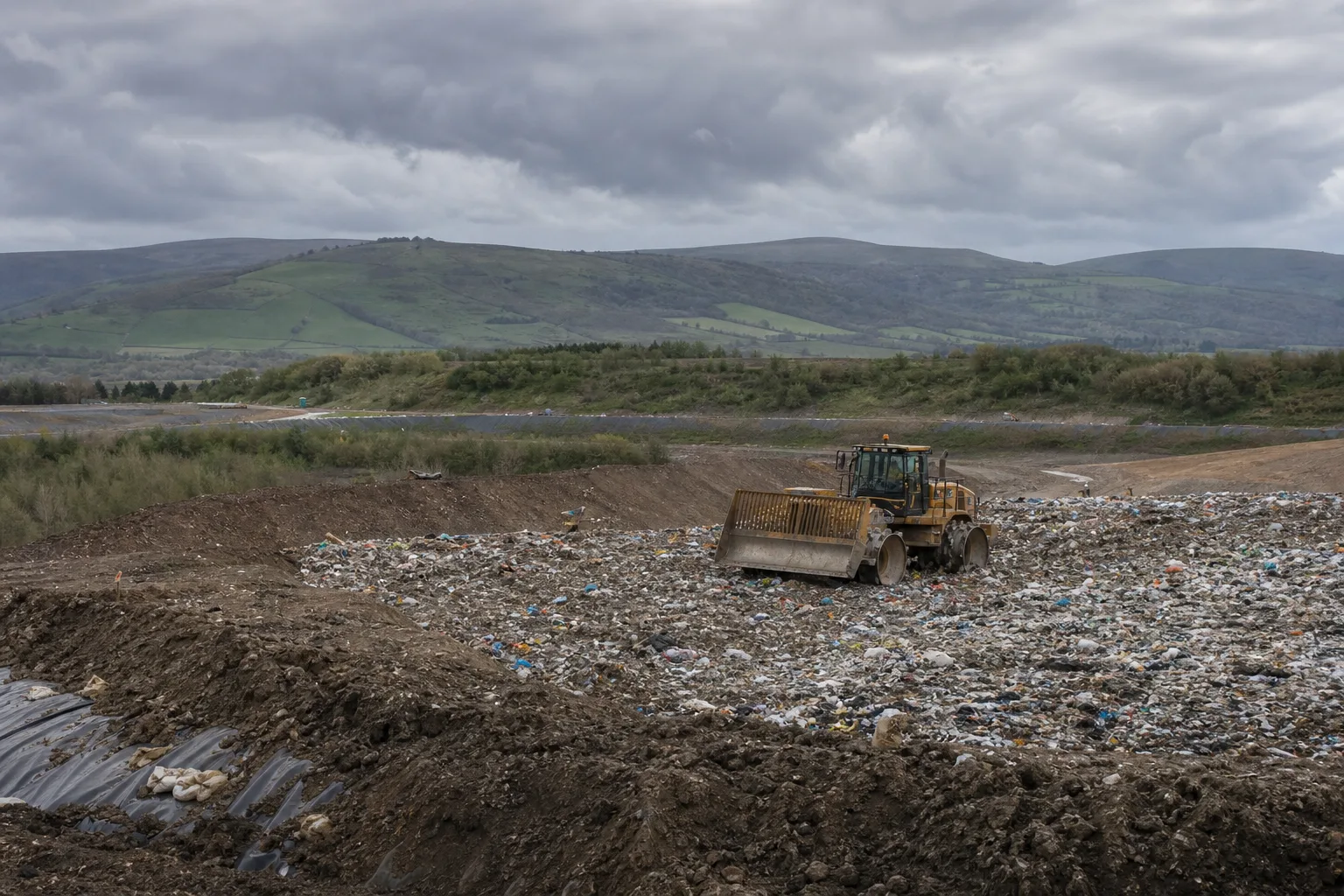
Modern UK landfills are engineered containment sites, not open dumps. Household rubbish that cannot be recycled or recovered is compacted, buried in lined cells, and monitored for decades to prevent liquids and gases from escaping into soil and groundwater.
From Tip to Engineered Cell
When your black bin is emptied, residual waste usually travels to a transfer station, then to a landfill permitted by the Environment Agency. The site is built in phases: a clay or synthetic liner, drainage layers, and a leachate collection system sit beneath the waste. Trucks tip on the active cell, bulldozers spread and compact material to maximise space and reduce voids where gas could migrate unpredictably.
Each cell is capped with soil or membrane when full, and restoration plans may include grassland or habitat creation. Planning permission and environmental permits limit height, operating hours, and waste types. Hazardous wastes go to separate, highly controlled facilities—not the household landfill you might picture from old news footage.
Leachate, Gas, and Long-Term Care
Rainwater filtering through waste forms leachate, a contaminated liquid collected via pipes and treated on site or at a sewage works. Methane and carbon dioxide are generated as organic matter breaks down anaerobically. Landfill gas is extracted through wells and often burned in flares or engines to generate electricity, reducing greenhouse impact compared with uncontrolled venting.
Operators monitor groundwater, surface water, and gas around the site for years after closure. Financial bonds ensure money exists for aftercare even if the company disappears. Landfill tax—charged per tonne of active waste—makes disposal deliberately expensive to encourage recycling and recovery.
Why Landfill Still Exists
Despite ambitious recycling targets, the UK still landfills millions of tonnes annually. Some materials lack viable markets; some contaminated loads are rejected from MRFs; some regions have limited incineration capacity. Inert waste such as clean rubble may go to separate quarries with simpler controls.
Policy direction favours landfill only as a last resort. The waste hierarchy ranks prevention, reuse, and recycling above disposal. For householders, the practical link is clear: everything in the general bin may end up sealed underground for centuries if it is not captured earlier in the system.
Closing Sites and Legacy Issues
Many Victorian-era tips were unlined and still produce pollution. Remediation is costly and slow. Modern standards avoid repeating those mistakes, but closed landfills remain on registers long after the last lorry leaves. Communities near active sites often negotiate traffic routes, odour controls, and dust suppression as part of permit conditions.
How This Works in London
London exports much residual waste by rail and road to landfills outside the M25 because inner boroughs have almost no disposal capacity left. Croydon and outer boroughs similarly rely on regional hubs; collection vehicles consolidate at transfer stations before long-haul articulated lorries move compacted waste to permitted sites in the Home Counties or beyond.
Inner areas like Hackney focus on shrinking the black bin through food waste and recycling because every tonne landfilled pays tax plus transport. Residents with bulky mixed waste should use licensed collectors rather than informal dumping, which still ends up costing the public through clean-up. Check areas we cover for compliant collection options.
How This Works in Birmingham
Birmingham’s residual household waste has historically travelled to landfill and energy recovery facilities in the wider Midlands. Birmingham City Council’s collections prioritise diverting recyclables and garden waste first; what remains in grey or black bins follows the residual route.
Landfill tax increases year on year, which is one reason the city promotes food waste caddies and clear recycling instructions. Fly-tipped waste cleared by the council still consumes landfill space and budget. Our Birmingham guide and Selly Oak locality page summarises local disposal routes and how to book bulky collections.
How This Works in Manchester
Greater Manchester sends residual household waste largely to energy-from-waste plants at Runcorn and elsewhere, with landfill used for ash residues and materials that cannot be burned safely. The combined authority reports diversion rates improving as food recycling rolls out across boroughs.
Landfill remains the backstop for rejected loads and certain inert wastes. Manchester City Council residents should assume general bin contents are destined for recovery or landfill—not sorted by hand at the kerb. Details on local services appear on our Manchester area page, Didsbury rubbish removal.
Frequently Asked Questions
Are UK landfills still open?
Yes, but capacity is shrinking. Most residual waste that cannot be recycled or recovered still goes to permitted landfill cells.
What is landfill tax in 2026?
Landfill tax continues to rise annually, making disposal the most expensive route for mixed residual waste.
How long does a UK landfill site operate?
Large sites can operate for decades under Environment Agency permits, with decades more required for aftercare monitoring.